Author name: Ayanshi@

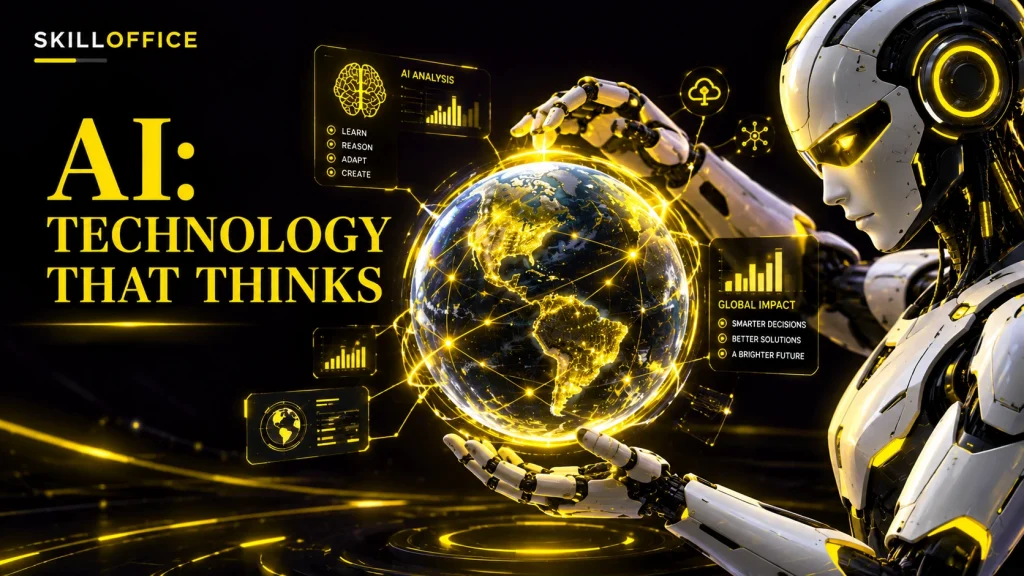
Futuristic AI robot holding a glowing Earth with yellow digital networks on a dark background.
Artificial Intelligence

AI: Technology That Thinks

Introduction Imagine a technology that can answer questions summarize documents generate images, write computer code and help solve problems. These abilities are not something we imagine anymore. Artificial Intelligence is making them real, through systems that process information and give answers. I think AI is sometimes called technology that thinks because AI can do tasks that look smart. AI can find patterns understand language make guesses and create content using the information AI has learned. The word “thinks” must be understood carefully. AI does not truly have awareness, emotions or the way humans understand things. Its abilities come from math tricks from the data it has learned from from how it’s set up and from the directions it receives. What Does It Mean When AI Appears to Think? Artificial Intelligence is, about computer systems that are built to do tasks that usually require intelligence.I find that these tasks can include understanding language, recognizing images making predictions, planning actions and creating content. All of these tasks are handled by Artificial Intelligence. Artificial Intelligence handles all of these tasks. The way artificial intelligence works is different, from how people think. AI can provide an answer that looks clever. Generative AI takes these language patterns. Uses them to create content such, as text, images, sounds or other kinds of media. For example when someone asks an AI assistant to explain something the system reads the question. Then the system gives an answer using what it has learned from training. The information it has on hand. This can look like thinking. I notice that the way AI works is not the same, as how humans think. AI might give an answer that seems smart. It does not truly understand what it means. It can also make errors. Get confused when faced with something new. So it’s important to see AI not as a thinking mind, like ours. As a powerful tool that uses smart math and data to do useful things. How Artificial Intelligence Works Data Processing: I see that many AI systems rely on data to find patterns learn how things relate or help make predictions. Data quality can strongly affect how useful the results are. Machine Learning: I notice that machine-learning systems use algorithms to learn patterns from examples. Machine-learning systems can then use those patterns on information but only within the limits of their training and design. Natural Language Processing: I find that language technologies help systems read text understand prompts make summaries of documents and come up with answers. Generative Models: I understand that generative AI systems create content from patterns learned during training.. Generative AI outputs are not always true or new, in every case. Tools and Workflow Integration: I realize that some AI systems can use approved software tools fetch information or carry out linked tasks. Tools and Workflow Integration actions should be controlled with permissions and monitoring. AI does not work the way in every situation. Each system is built for a job. That’s why it’s important to know what each one is meant to do. AI Trends Shaping 2026 Generative AI tools : It can create text, pictures sounds, movies and computer programs. Generative AI tools help with both technical tasks. AI agents: It can do a series of tasks that have goals and can use approved tools. AI agents are being looked at by businesses for research, reporting and everyday work. Multimodal systems : It can read or listen to text look at images hear sounds and watch video at once. Multimodal systems let people interact in a way. AI-powered search and research tools : It can make summaries and sort information. AI-powered search and research tools remind people to look at the sources when facts are important. Responsible AI : It means caring about privacy, openness, safety and checking how well it works. Responsible AI is key as AI is used more in jobs. I understand that these trends show that AI can help with things but they do not replace the need, for human thinking. Real-World Applications of AI In education AI can explain concepts create practice questions and help learners organize study materials. AI makes learning easier and more focused. In healthcare AI can assist with research handle image‑analysis tasks and manage work.I believe AI still needs experts and careful checks to guarantee that medical decisions made by AI are safe and correct. I think AI can help us sort documents make reports handle customer service and automate routine workflows. AI, in business operations can make things easier. This saves time. Reduces errors in daily tasks. In work AI can generate first ideas, for images, presentations and written content. Then human creators can improve those ideas to match their goals and vision. Across all these areas AI works best when it helps with a job and when people can review its output carefully. It’s not meant to replace humans. To support them. Benefits and Limitations of AI Technology I see that AI can help people work faster by reducing the number of tasks they need to do. It can also help them manage information quickly. AI can support learning. Find patterns in data that might be hard to notice alone. I believe businesses can gain a lot from using AI. They can improve their workflows create reports and send personalized messages to customers.I also see individuals using AI to keep track of tasks learn about topics and create drafts of ideas. Ai has limits. It can produce incomplete answers. It might misunderstand what you ask or give results that show bias. The way you write a prompt can strongly influence the output. Some AI systems also have trouble with current news or deep expertise, in certain fields. Risks arise when privacy and security are threatened by sharing data without protection. Automated tools can make errors when automated tools are given much access or not enough control. People should check results carefully. They should keep data safe and not assume that smooth-sounding
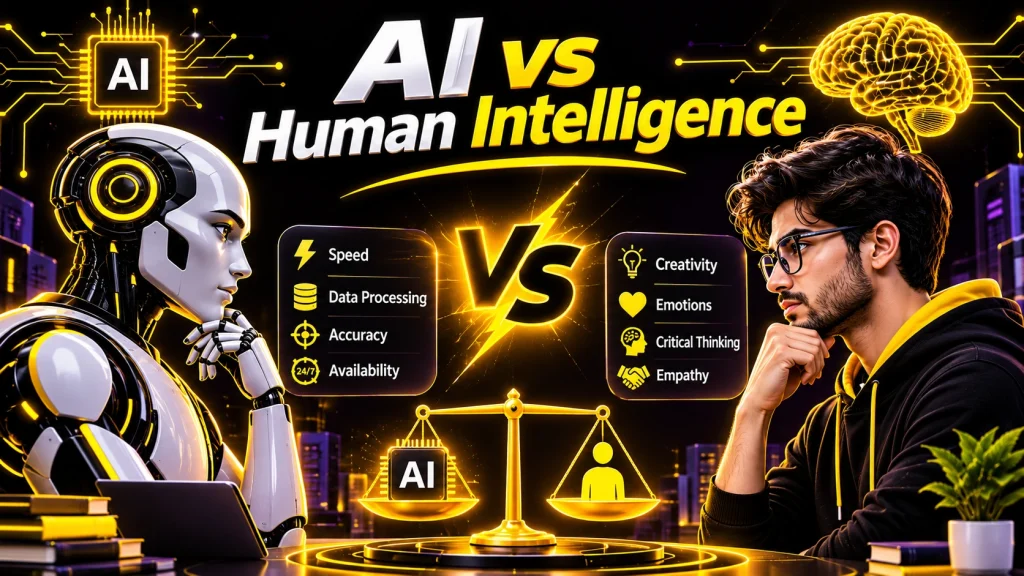
AI vs. human intelligence illustrated by a robot and a man with glowing yellow comparison graphics.
Artificial Intelligence

AI vs Human Intelligence 🧠🤖: Key Differences

Introduction I have seen how Artificial Intelligence changes the way people work the way people learn the way people create and the way people solve problems. From Artificial Intelligence writing assistants and chatbots to data analysis tools machines can now do tasks that used to take lots of effort.This development brings up a question: Can artificial intelligence come close to intelligence? AI and human intelligence each have their strengths. AI systems can process amounts of information find patterns and complete repetitive tasks very quickly. Humans on the hand bring understanding, personal experience, creativity, ethical thinking and the ability to understand complicated social situations. AI and human intelligence each have their strengths.AI and human intelligence each have their advantages. AI systems can deal with amounts of information find patterns and complete repetitive tasks quickly. Humans, on the hand bring understanding, personal experience, creativity, ethical thinking and the ability to understand complicated social situations. By 2026 the discussion is no longer about AI versus humans. It’s shifting to a practical focus: How can people and AI work together well? Recognizing the differences, between them helps individuals, professionals and businesses make choices. It also helps everyone prepare for a future shaped by technology. What Is Artificial Intelligence and Human Intelligence? Artificial Intelligence means computer systems that are built to perform tasks that involve thinking. I think I think Ai systems use methods such, as machine learning, deep learning, natural language processing and generative models. I find that Artificial Intelligence learns patterns from data. I also notice that Artificial Intelligence learns patterns from data. Artificial Intelligence learns patterns from data.. AI follows programmed processes to create results for tasks. I notice that Human intelligence is the ability to learn, to reason to understand experiences to adapt to situations to communicate and to make judgments. Human intelligence includes abilities such, as memory, creativity, emotional awareness and social understanding. I see that for example an AI tool can generate a marketing campaign draft, from existing information. A human marketer can then interpret the audience’s emotions consider context understand the brand’s personality and decide whether the campaign is appropriate. Key Differences Between AI and Human Intelligence Artificial Intelligence and human intelligence both play roles in solving problems and understanding the world. I find that Artificial Intelligence and human intelligence differ in ways especially in how they learn how they process information how they show creativity and how they make decisions.  AI Trends Shaping Human-AI Collaboration in 2026 Artificial Intelligence and human intelligence both play roles in solving problems and understanding the world. I find that Artificial Intelligence and human intelligence differ in ways especially in how they learn how they process information how they show creativity and how they make decisions.  Generative AI: Writing tools, image tools, video tools and coding tools help people make versions think about new ideas and make regular work go faster. Checking the work done by these tools is still important to make sure the work is good and original. AI Agents and Automation: AI Agents and Automation tools adjust to preferences. Make daily tasks easier. AI Agents and Automation tools sort data, highlight points. Keep things running easily. Personalized AI Assistants: Personalized AI Assistants can help users organize information prepare summaries and manage workflows according to their needs. I find Personalized AI Assistants very helpful. AI Powered Analytics: Businesses can use intelligence to find patterns in campaign results in customer behavior and, in data. I think people still need to check the assumptions and the reliability of what artificial intelligence finds. AI: Privacy is important, Security is important. Transparency is important. Fairness is important. Accountability is important. Accountability is important because AI becomes part of work. Accountability is important because AI becomes part of work. Benefits of Combining AI With Human Intelligence Higher Productivity: AI can take care of tasks that’re repetitive like organizing information making summaries of documents and creating first versions of written work. People can then concentrate on planning making decisions and handling complicated jobs. Better-Informed Decisions: AI can find patterns and show choices. Human professionals can look at the information think about the situation. Decide which suggestions are useful. Creativity: Designers, writers and marketers can use AI to look into different ideas and then use their own original thoughts and past experiences to make better outcomes. Customer Experiences: AI can help companies understand what customers like while human workers offer care build connections and offer thoughtful service. Faster Learning: Students can use AI to get easy explanations solve practice problems and see examples. tudents can use intelligence to get explanations solve practice problems and see examples. Human teachers can give advice, support and more, in-depth understanding. For example a digital marketing agency such as Skilloffice can use AI to study topics and review campaign data. However a digital marketing agency still needs workers for brand strategy, creative direction, quality checks and for building relationships, with clients. Challenges and Limitations of AI and Human Intelligence AI can give answers. It can show ideas from the data it learned from. It can also not work well when it sees something. AI can create problems with privacy and security . People make mistakes when they are tired. They might not have all the facts. They can also think in ways that’re not fair. They might not be able to look at amounts of data fast. Another problem is trusting AI much. If people believe everything AI says without checking they might miss errors. They might also not get better at solving problems on their own. Jobs are changing because some work is done by machines now. People might need to learn computer skills. They might need to know how to watch over AI tools. To fix these problems companies should teach workers. They should check results. They should keep information safe. They should make rules, about when a person must say yes before something happens. Challenges and Limitations of AI and Human Intelligence 1. What is the main difference

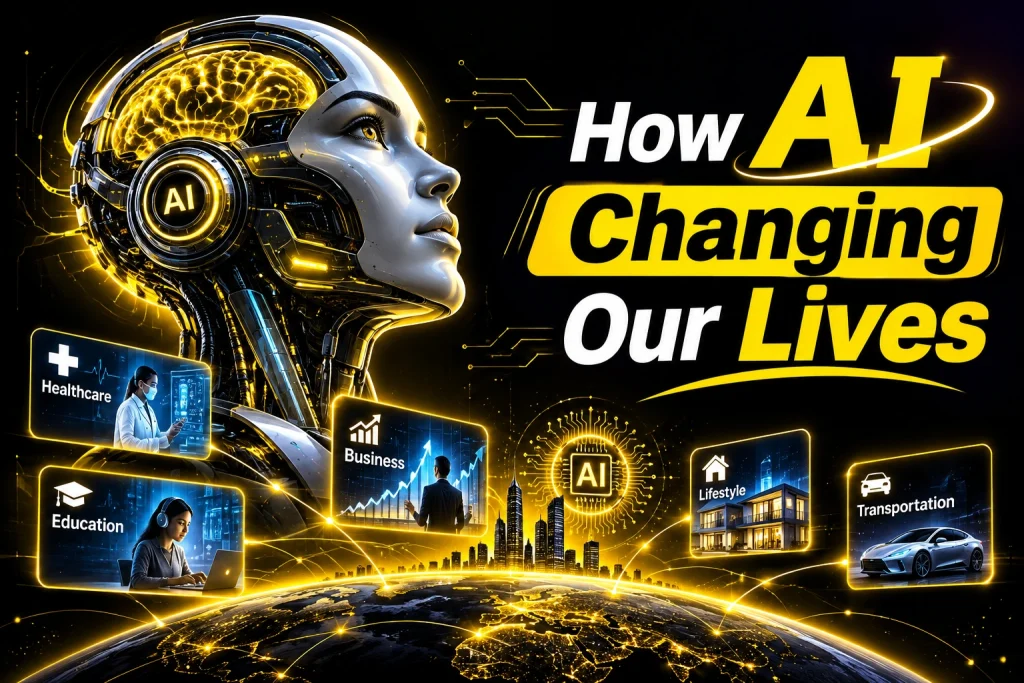
Futuristic AI robot illustrating how artificial intelligence is transforming healthcare, education, business, and everyday life.
Artificial Intelligence

How AI Is Changing Our Lives🧠🤖

Introduction Many people interact with Artificial Intelligence every time they use search engines watch videos that are recommended navigate routes talk to assistants or shop online. I see that Artificial Intelligence is changing how people learn, how people work, how people handle information and how people talk to each other. I realize that tasks that used to take a lot of time and effort can now be helped by apps. These apps create content shorten documents find patterns and do work automatically.In 2026 Artificial Intelligence is showing up more in services. How professionals get their work done. It makes things easier. Opens up new possibilities. It also raises some questions. Like how safe our private information is, whether the results are correct what this means for jobs and just how much we’re letting technology take over. Understanding how Artificial Intelligence is shaping our lives can help people pick the tools and prepare for a future where digital intelligence is part of the mix. How Artificial Intelligence Works in Everyday Life Artificial Intelligence helps computer systems do tasks that usually need thinking. This includes understanding words finding patterns looking at pictures and suggesting things.I feel like many AI systems work behind the scenes without people noticing. Recommendation systems suggest videos, songs or items based on what people watch or like. Navigation apps check traffic to help people choose the way to go. Email programs use systems to spot unwanted messages and sort the rest. I think Generative AI tools are different because Generative AI tools create text, pictures or computer code using instructions and learning. Generative AI tools can make everyday life easier. They do not always work perfectly. Suggestions can be, off-topic the information they create can be wrong and the choices they make can show unfairness. Top AI Trends Influencing Everyday Life in 2026 Voice and Multimodal Interaction: These systems can work with speech, text, images and video. I find that using these systems creates ways to interact with technology. Privacy and Digital Safety: As artificial intelligence becomes more common keeping information safe and spotting fake or confusing content are becoming more and more important skills. Generative AI: Artificial intelligence tools can help with writing making images coming up with ideas and studying. They can save time when doing work and people checking the work can make it better and more unique. Smart Automation: Artificial intelligence powered systems can help with setting schedules handling customer service controlling home devices and doing business tasks. How AI Is Transforming Education, Healthcare, and Work Education: AI learning tools can explain ideas. They can make practice questions. They can sum up reading material. They can help students study at their speed. Students should check the facts. Students should obey rules. Students should keep building thinking. Healthcare: AI said research, administrative tasks and some image analysis. I see how AI can help professionals. AI can help professionals deal with information fast. AI does not replace trained judgment or emergency care. Workplaces:Professionals can use intelligence to summarize documents create reports, arrange research and help with tasks that happen over and over. Workers who take the time to check what AI produces and use the tools in the way might be more ready, for new ways of working. Communication: I find translation, transcription and writing assistance can make communication easier, across languages and situations. However important messages still benefit from review and context. Small Businesses: AI can help entrepreneurs research audiences prepare content drafts, answer questions and review business data How AI Is Changing Shopping, Entertainment, and Daily Tasks In shopping recommendation systems can suggest products by looking at what people browse what they have bought before and what they say they like. Stores might also use intelligence to help with keeping the right stock in inventory and to improve customer service. Entertainment streaming platforms use recommendation systems to suggest movies, songs and videos. Recommendation systems give suggestions that help people find things they might enjoy. They can also limit the variety of content people see. For tasks AI helpers can assist with writing shopping lists organizing routines summarizing notes and coming up with ideas, for personal projects.Smart‑home systems can control lights adjust temperature and manage devices. Smart‑home systems keep your home comfortable. Help save energy. Convenience should not mean giving up privacy or careful decision making. People should look at what app permissions they’re giving understand privacy settings and do not trust automated suggestions completely. I believe privacy is important to think about needs and make choices based on what matters. Strategies for Using AI Wisely in Everyday Life Artificial Intelligence helps people manage tasks learn new skills organize information and solve problems. It is important to pick the tools that match your needs and give directions to get results. I have seen that Artificial Intelligence can help with things, such, as writing emails, planning schedules exploring ideas and understanding topics.Users should always check the information. Users should protect their details. Users should not rely on AI for every decision.Using tools along with thinking skills and creativity and experience can lead to better results. When people use AI with a goal, in mind they can save time and increase productivity and make daily tasks more efficient. Frequantly Asked Question 1. How is AI changing our daily lives? AI supports everyday activities through recommendations, digital assistants, translation, navigation, content creation, and automation. 2. What are common examples of AI in daily life? Examples include spam filters, navigation apps, video recommendations, voice assistants, shopping recommendations, and AI writing tools. 3. How does AI help students? AI can explain concepts, generate practice questions, summarize materials, and support personalized learning when used responsibly. 4. Is AI safe to use in everyday life? AI can be useful, but users should protect their data, verify important information, review permissions, and avoid relying blindly on automated outputs. 5. Will AI replace humans in daily activities? AI may automate certain tasks and change how others are completed. Human judgment, creativity, empathy, and

Artificial Intelligence

AI — A Revolution Beyond Imagination

AI: Shaping Tomorrow, Today I think Artificial Intelligence or AI is changing the world in ways that used to feel impossible. From chatbots and AI‑generated content to fully automated business tasks and deep data analysis Artificial Intelligence is altering how people work, learn, talk and solve problems. I believe the special part of this change is how fast Artificial Intelligence tools are becoming easy to use. Anyone can use AI to create ideas students can dive into subjects and companies can streamline their work without having to build every solution from the ground up. I notice that in 2026 the AI revolution is going beyond automation to offer more personal experiences, smart assistants and linked workflows.. This progress also raises key questions about privacy, accuracy, jobs and how we use technology responsibly. I feel that knowing the trends and tactics can help people and businesses make the most of Artificial Intelligence while getting ready, for its challenges. Understanding the AI Revolution Those tasks are finding patterns, understanding language making content looking at pictures and guessing what will happen next. Artificial Intelligence uses technologies. Machine learning helps systems spot patterns in data. Machine learning can find shapes in numbers. Natural language processing helps computers understand words. Natural language processing can. Write sentences, like a human. Computer vision lets systems read pictures. Generative AI can create text, pictures sounds, movies and even code. For example an AI assistant can keep research organized. I also notice that a marketing team can use AI to think up new campaign ideas. Companies can also use AI for customer service for making reports and for paperwork. Ai does not think or understand every situation, like a human. It can give incomplete answers so human judgment is still needed.The real revolution is how people mix these technologies with knowledge, creativity and real problem solving. Top Artificial Intelligence Trends in 2026 Generative Ai: Generative tools help people make content think about ideas explain information and write first versions. Companies are adding them to marketing, design, programming and communication processes. AI Agents and Workflow Automation:  AI agents can do a set of tasks using the tools they have and the directions they get. Companies are looking into using them for research setting up schedules answering customer questions and making reports. Right permissions and people watching over them are still very important Multimodal AI: Some artificial intelligence systems can handle types of information such, as text, pictures, sounds and videos. This allows for natural conversations and the creation of new kinds of applications. AI-Powered Personalization: They can track what people like look at how people behave and see what is happening with trends. Then they can give suggestions that’re more relevant send messages that are better and create better online experiences. Responsible AI: When building or using intelligence systems things, like privacy, openness, fairness, safety and the quality of results are becoming more and more important. How AI Is Transforming Different Industries I believe that education AI tools can act as learning assistants. Education AI tools can simplify topics create practice questions and help students learn in a way that fits the needs of each student. Still students must build their thinking skills. Make sure to verify the information that education AI provides. In marketing marketing AI can help with keyword research generate content ideas, study audience behavior and summarize how campaigns are performing. Marketers can use these ideas to make decisions. Human creativity and the real voice of the brand must stay at the center. In my way artificial intelligence is important. In manufacturing artificial intelligence can help check product quality, plan maintenance and predict production. In retail artificial intelligence can spot demand trends track stock levels and recommend products that match customer interests. Customer service teams can use intelligence chatbots to answer questions and complex problems to real people. AI speeds up the process while keeping service personal and effective. Benefits and Challenges of the AI Revolution I think Artificial Intelligence offers advantages. Artificial Intelligence can do work examine large sets of data help with creative projects make experiences more personal and let people find information faster.For businesses Artificial Intelligence tools can make some tasks easier when resources are small. Entrepreneurs can use Artificial Intelligence for research for planning content for talking with customers and, for reports. Artificial Intelligence also brings problems. Content that Artificial Intelligence creates can have facts biased systems can give unfair results and bad data habits can risk privacy. Overusing automated tools can also cut chances for people to learn their problem‑solving ways. Employment is another issue. Some jobs may turn into tasks while the need grows for people who can check Artificial Intelligence results, run systems, guard data and solve hard problems. Organizations must deal with these worries by giving workers training writing rules testing often and keeping human control. The Future of AI: Opportunities and Responsibilities In the future AI will probably bring digital helpers, more efficient automation and stronger connections, to everyday programs. AI will increasingly assist people with research, planning, analysis and complex step‑by‑step tasks. For students and professionals learning how to use AI tools well can build digital skills. Businesses can use AI to improve their work learn about customers and create services.Still the future of AI depends not on technology. I believe that it also depends on building foundations that protect privacy provide information and keep people involved in decisions. I think creativity, empathy, communication, leadership and good moral judgment will remain important in a world filled with AI tools. the best approach is to treat AI as a tool that adds to our skills not as a replacement so that we think carefully. Frequently Asked Questions (FAQs) 1. Why is AI considered a revolution? AI is considered revolutionary because it enables new ways to automate tasks, analyze information, generate content, and support decisions across many industries. 2. What are the biggest AI trends in 2026? Important trends include generative AI, AI agents, workflow automation, multimodal systems,

Artificial Intelligence

The Rise of Artificial Intelligence

Introduction Artificial Intelligence has become one of the important technology developments of the modern era. Artificial Intelligence is no longer limited to research laboratories or large technology companies. Artificial Intelligence is now available, through applications, online platforms, smartphones and business software. Artificial Intelligence has changed our lives in ways. In my opinion how people rely on Artificial Intelligence assistants to answer questions create content shorten information and keep their work organized. I also notice that companies are looking at Artificial Intelligence to automate tasks make customers happier and analyze data quickly.. People are using Artificial Intelligence more and more each day. I see that many of us depend more on Artificial Intelligence tools. Artificial Intelligence helps us with work. This fast spread of Artificial Intelligence is changing how firms compete and how people grow skills.To make Artificial Intelligence work well we need more, than using the tools. Artificial Intelligence needs goals, reliable information, good data protection and a clear understanding of the limits of the technology. I believe that careful planning is essential. By exploring how Artificial Intelligence is rising its current trends and practical strategies people and businesses can better prepare for the opportunities ahead. I encourage everyone to stay curious and keep learning. What Is Driving the Rise of Artificial Intelligence? First a lot of data gives information that artificial intelligence systems can use to find patterns and make predictions. Second better computing systems and machine-learning methods have made complex applications possible. Third cloud services and easy-to-use tools have made artificial intelligence available to people who do not have technical knowledge. Generative artificial intelligence has also made more people interested, by allowing them to create text, images, audio and code using language instructions. Companies are using intelligence because it can help with tasks that happen over and over it can assist with looking at information and it can make certain ways of working better. People are trying it out to learn things to manage their time and to work on creative ideas. Using intelligence should not be judged only by how many tools a person or company uses. I think the real value of intelligence is found in whether intelligence solves a problem and delivers correct results. Major AI Trends Shaping 2026 Generative Ai : I see that Generative AI is getting added into research, design, marketing and software development by organizations. Human review remains important, for making sure the work is original, accurate and high quality. Ai Agent : Perform connected actions toward a goal when given the right tools and permissions. Businesses are testing AI Agents for operations, research and workflow coordination. AI Power Analytic : I have noticed that AI‑Powered Analytics can help summarize reports, spot patterns and aid forecasting. These abilities can make decision‑making better when the data is suitable. The outcomes are examined carefully.  Personalized Experiences : It is used by businesses to help give recommendations to communicate with customers and to create content that fits each person. Responsible data practices are needed to keep customer trust.  AI Security and Governance :  Needed as adoption increases. Organizations need processes, for data privacy, access control, output verification and risk management. How AI Is Changing Businesses and Careers I see that Marketing teams can use intelligence to come up with campaign ideas. Marketing teams can look at how customers behave. Marketing teams can do keyword research. Marketing teams can write the versions of content. I also see that Customer service teams can use chatbots to answer questions. Customer service teams can send complicated issues to the right people. Finance teams can use intelligence to spot strange patterns in money transactions and get reports ready. If you are a manufacturer you can use intelligence to help check the quality of products and plan when machines need maintenance. If you are a teacher you can use intelligence tools to make study materials and design practice problems. Artificial intelligence is also changing what jobs require. Some tasks that people used to do by hand might not require effort anymore but new jobs are showing up in areas like AI management, data analysis, security making things automatic and planning digital strategies. People can get ready, for these changes by getting better at using technology. These skills include speaking, being creative thinking clearly working with others and solving problems. The goal is not to fight against intelligence but to find ways to use intelligence properly while keeping the knowledge and experience that people have. AI can make work easier by taking care of tasks that happen over and again. It can also help people deal with a lot of information. AI can encourage ideas help with finding information make things more personalized and make some online services easier to use. Small businesses can also get benefits that used to take time or money. AI can help with planning in the beginning writing content and looking at data in a way. As more people use AI there are some dangers. Systems can give answers show unfair preferences or share private details if they are not used carefully. Automated choices can also lead to results if they are not tested properly. Another problem is when people rely much on AI. They might trust the suggestions, from AI without checking if they are right or if they fit their situation. Companies need to have people watching over AI use security teach employees and keep checking everything to handle these problems. The Future of Artificial Intelligence I believe artificial intelligence will be closely connected to software, company tasks and online services. AI helpers might assist with processes. Improvements, in systems that work with types of data could make it possible to communicate using text, pictures, sound and videos. At the time responsible AI adoption will remain important. Organizations will need to manage data evaluate how well the system works and make sure that automated decisions are suitable for their intended use. For individuals the ability to learn all the time and adapt to

Artificial Intelligence

Artificial Intelligence: Changing the World

A New Era of Artificial Intelligence Artificial Intelligence is changing the world. Artificial Intelligence changes the way people communicate with each other. I have noticed that Artificial Intelligence changes the way companies manage their work in different ways. Artificial Intelligence helps different areas solve problems. Jobs that once took a lot of time and effort can now be done by programs that look at information write text and handle chores. From voice helpers and suggestions on the internet to work in hospitals and factories with machines AI is becoming a part of the digital world around the globe. The effect of AI keeps increasing as companies find methods to make things run better create better services and learn more about what people need. The effect of AI is not just about making life easier. It brings up questions about jobs keeping personal details safe making sure information is correct and who is responsible for the people who make the technology. Learning about how AI’s changing the world helps people, workers and companies get ready for future chances while making smart choices, about the dangers involved. Understanding Artificial Intelligence and Its Growing Importance Machine learning helps computers find patterns, in data. Natural language processing helps computers read and write language. Computer vision allows computers to look at pictures and videos. Generative AI lets computers create things from what Generative AI has learned. I find that each of these areas works together to make technology smarter. These tools are easier to use. You can find them on websites in phone apps on cloud services and, in business software. AI is useful because many companies create and handle amounts of data. When artificial intelligence is used properly artificial intelligence can help people organize data, spot patterns and cut down on tasks. I have seen that artificial intelligence does not see the world the way people see it. When I use intelligence properly artificial intelligence can help people organize that data find patterns and reduce the amount of repeating tasks. I have seen that artificial intelligence does not see the world the way people do.. Artificial intelligence might make errors show preference or overlook information. A human review is still required when we need precision and accountability. Major AI Trends Changing the World in 2026 AI-Powered Personalization: In my opinion digital platforms can use what customers like and what they do to recommend products, information or services that match the person. Companies need to make sure that using intelligence to personalize things is done in a way that respects privacy and has clear rules, about data. Responsible AI: In my view companies are paying attention to the trustworthiness, fairness, safety and openness of AI systems. Implementing AI is key, to building trust and cutting down possible harm. Predictive Analytics : Organizations use intelligence to look at data and try to guess what might happen in the future. This helps with things like planning how product to stock knowing when machines might need repair and understanding how customers might act. It’s important to be careful, with these predictions. Just because something happened before does not mean it will happen again. Ai Power Personalization: Digital platforms use what customers like and what they do to suggest products, information or services that fit. I see that companies must ensure that personalization respects privacy and that their data practices are clear and honest. How AI Is Changing Different Industries Healthcare: AI can help research look at certain medical pictures support admin tasks and help researchers study big data sets. Clinical decisions need oversight and validation. I see that AI is not a replacement, for a doctor. I think a tool that can speed up work and give time for judgment would be great. Education : I believe that in education AI tutors and learning helpers can explain topics create exercises and let learners practice at their pace. Teachers can use AI to create teaching materials while encouraging thinking and keeping fairness. I think that AI can give each student a chance to learn the amount of new information Business and Marketing : Companies use intelligence to study audiences look at campaign results write content drafts make customer support better and handle routine tasks. Human experts still play a role, in shaping brand strategy coming up with original ideas checking facts and building strong relationships. Manufacturing: In manufacturing artificial intelligence can help find defects, in products predict when machines need maintenance and improve planning. When used properly these tools can reduce waste. Make operations smoother. Lead to smoother more reliable operations. Transportation and Logistics: AI can help with route planning looking at traffic managing warehouses and predicting when deliveries will happen. Important systems that could affect safety need testing and careful checks. Banking and Finance: AI can spot ways money moves look at some kinds of risks and make helping customers better. Decisions that control if people can get services need to be watched to make sure they are right and fair. These examples show that artificial intelligence is not for one area. Its importance comes from fixing issues in a safe and efficient way. Benefits and Challenges of Artificial Intelligence AI has an advantage: efficiency. When AI automates tasks people get more time, for planning, creative work and building customer relationships. I see that artificial intelligence also helps analyze data sets. It speeds up research. It improves personalization. It makes digital services easier to use. For businesses intelligence tools can make many useful features more affordable. A small team may use intelligence to organize research. A small team may use intelligence to draft marketing content. A small team may use intelligence to summarize reports. A small team may use intelligence to answer customer questions. Privacy and security: When information is not handled properly it can put people and companies in danger. Losing privacy can hurt individuals and harm businesses. Bias and fairness: Intelligence tools can copy patterns that already exist in the data that intelligence tools learn

Artificial Intelligence

AI: The Future Is Here 🤖

Introduction I have seen how Artificial Intelligence (AI) is no longer an idea that appears only in science fiction films. Artificial Intelligence (AI) has become a part of our lives and it changes the way we work learn, speak, shop and solve problems.From assistants and AI chatbots to automated business systems I see that Artificial Intelligence (AI) creates possibilities for both individuals and businesses. In 2026 Artificial Intelligence (AI) keeps evolving with tools such, as Artificial Intelligence (AI) smart automation, personal experiences and decisions made by Artificial Intelligence (AI). Businesses use these tools to improve work learn about customers and create solutions. However the future of Artificial Intelligence (AI) is not about new tech. The future of Artificial Intelligence (AI) is also about using Artificial Intelligence (AI) keeping personal data safe and mixing machine smarts with human creativity. Understanding these changes can help people and companies get ready, for a digital future. What Is Artificial Intelligence and How Does It Work? Artificial Intelligence is a part of technology that allows computer systems to do tasks that usually need thinking. I think it is really amazing how Artificial Intelligence can understand words look at pictures read data find patterns and even make content. Artificial Intelligence systems use methods such, as machine learning, natural language processing, computer vision and deep learning to deal with information and provide outcomes. I have seen examples of Artificial Intelligence, in life. I have seen examples of Artificial Intelligence, in life. For example an Artificial Intelligence writing assistant can help make an article plan and an Artificial Intelligence customer service chatbot can answer questions. Also Artificial Intelligence recommendation systems suggest items, videos or songs depending on what users do.Artificial Intelligence recommendation systems often surprise me with music or videos. Artificial Intelligence usually functions, by looking at data finding patterns and using those patterns to make guesses, suggestions or replies. I notice that the accuracy of Artificial Intelligence depends on factors. The effectiveness of Artificial Intelligence depends on the quality of Artificial Intelligence data, how Artificial Intelligence systems are built and how people use and verify Artificial Intelligence answers. Top Artificial Intelligence Trends in 2026 Generative AI : Generative AI can make text, pictures, videos, sounds and computer code. It helps marketers write words students understand things and businesses make helpful things faster. These tools help people turn ideas into things. AI Agents and Smart Automation : AI agents can do a list of tasks by following directions. They can assist companies with research help with customers create reports and handle office jobs. This takes time out of the day. Cuts down, on boring work but humans still have to look over what they do. Personalized Digital Experiences : I have seen how AI helps businesses understand what customers like and need. Using this information businesses can suggest products send relevant messages and create better website experiences. This helps customers find what customers are looking for easily. AI-Powered Data Analysis : AI tools can look at amounts of information and spot useful patterns. Companies can use these tools to understand how customers act predict what might happen in the future and make better decisions.. It’s important to double check the results to make sure they are correct. How AI Is Transforming Businesses and Everyday Life Artificial intelligence is bringing changes to different industries. I think that in education artificial intelligence tools can explain ideas. Artificial intelligence tools can also create practice questions. Let students learn at their own speed. Teachers can use these tools to prepare lessons. These tools are still the ones who ensure the quality of learning. Healthcare intelligence helps with research by looking at scans, like X-rays and MRIs. Also handles some paperwork. Doctors and nurses have to keep checking everything. In marketing intelligence helps companies find keywords come up with content ideas check how campaigns are performing group customers, by interest and send routine messages. For customer service artificial intelligence chatbots answer questions and send more complicated cases to real people. In finance and retail artificial intelligence helps detect fraud predicts which products will be, in demand plans inventory levels and suggests items based on a person’s behavior. At a level artificial intelligence assistants help people manage time shorten long texts learn new skills and finish boring or repetitive jobs. Even though artificial intelligence brings advantages artificial intelligence should help humans than take over thoughtful choices, professional knowledge or individual accountability. Practical Strategies for Using AI Effectively Start with a goal: Think about a problem you want to solve. For example maybe you want to cut down on work that you do over and over again.. Maybe you want to make customer communication better.. Perhaps you want to make research faster. Pick AI tools that match that problem. Choose the tools: Look at the tools that’re available. Check what features they have. Think about how much they cost . Combine AI, with creativity: Use AI to come up with ideas. Use it to organize information. Use it to make drafts. Then add your knowledge. Add your thoughts. Add your style. Add your way of thinking before you share the results or use them. Protect data and privacy: Don’t put business information into tools that are not allowed for that. Don’t put passwords into tools that are not approved. Protect data and privacy: Don’t put business information into tools that are not allowed for that. Don’t put passwords into tools that are not approved. Watch how things go. See what works and what doesn’t. Write it down. Check it often. This helps you make choices later. Monitor every step. Watch for changes. See how things progress. Stay aware of results. Make sure nothing is missed. Look at time saved. Look at how many mistakes made. Check how customers feel. Check how good the content is. Check what happens to the business They help make progress that can be seen and measured. Benefits and Challenges of Artificial Intelligence AI offers several advantages. It can take

Artificial Intelligence

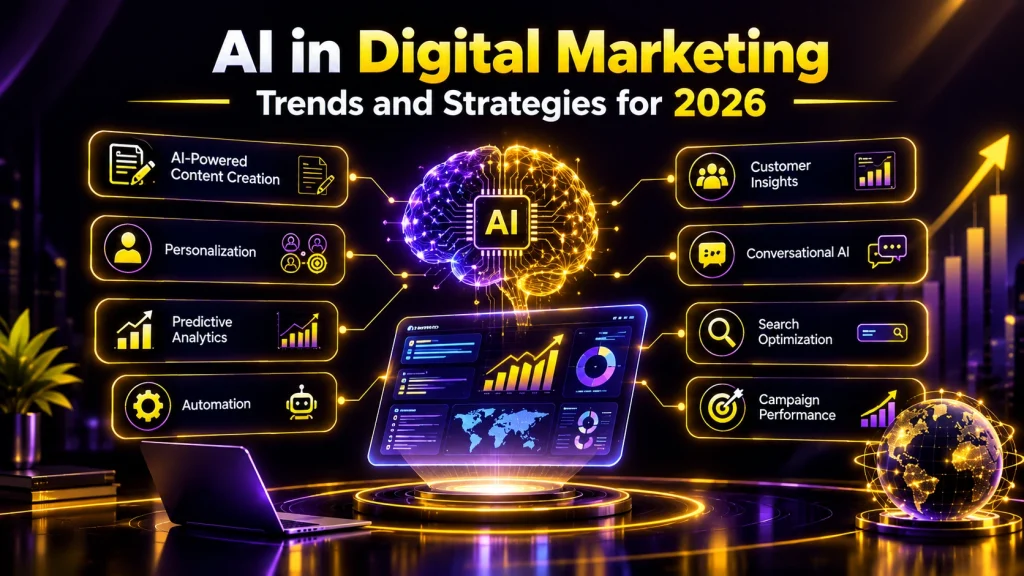
AI in Digital Marketing: Trends and Strategies for 2026

Introduction I see that artificial intelligence is changing the way businesses attract customers understand customers and connect with customers. In marketing ai is included. It helps with making content studying customer behavior doing tasks automatically and tailoring campaigns. In the past marketers spent a lot of time collecting data analyzing campaigns writing content and managing customer interactions by hand. Now tools that are powered by Artificial intelligence let businesses handle many of these tasks quickly and efficiently.  Successful artificial intelligence marketing does not rely on the tools. Companies must have a plan. That plan must blend intelligence technology with human creativity insights about customers and well defined marketing goals. By 2026 businesses that use intelligence well will focus on more, than automation. They will emphasize personalization. They will make decisions that deliver customer experiences and will measure the results. AI-Powered Personalization Is Becoming Essential AI makes this possible by analyzing how customers act what they enjoy how they connect with a brand and what they buy. Of sending the same message to all customers companies can use AI to create more personalized content and special offers. For example an online store can recommend products based on visits or previous purchases. An email campaign can send messages to different groups of customers depending on what each group is interested, in.AI can support personalization across: Email marketingWebsite experiencesProduct recommendationsSocial media advertisingCustomer communicationsSearch experiencesPromotional campaigns Before using AI I feel that AI companies must first figure out who their customers are and what they need. Using customer information AI companies can make groups that make sense and give experiences that truly matter to customers. AI Marketing Automation Saves Time and Improves Efficiency Marketing involves activities. Marketing includes scheduling campaigns organizing leads sending emails, analyzing performance and answering customer questions. AI automation can help with: Lead qualificationEmail workflowsCustomer supportSocial media schedulingCampaign analysisData organizationAudience segmentationFollow-up communication For example when someone who might buy a product fills out a form an automatic system can send them a message that makes sense away and also tell the sales people. Strategy: Begin With Easy Jobs Companies don’t have to make all their work automatic at once. Begin with tasks that happen often and don’t have risk. These tasks take up time. When the process is working well slowly add AI to complicated marketing work. Begin with steps check how it goes and grow what is successful. AI Is Changing Content Marketing and SEO Content marketing is another field where artificial intelligence is making a difference. I think AI tools can help marketers generate ideas, research topics build outlines refine drafts check keywords and adjust content for audiences. I believe creating a lot of AI-made content by itself is not a marketing strategy. Search engines and customers both prefer content that truly gives value. Businesses should treat AI as a tool to support their work not replace it. Human marketers still need to ensure the content is accurate original and matches the brand’s voice. AI can help with SEO in ways: – Finding new content opportunities – Understanding what users really want when they search – Suggesting topic ideas – Organizing content into clear structures – Spotting related questions people ask – Reviewing current content, for gaps The best strategy is to blend AI and creativity. Then I add experience, personal examples, strong opinions, fresh insights and the unique personality of the brand.This blend creates content that works better for both search engines and real people. The Future of AI in Digital Marketing: Trends and Best Practices AI in marketing will keep changing. It gives chances for businesses to learn about customers make workflows better and create campaigns that fit customers more. Using every new tool is not needed. The best way is to pick tools that fix problems. Here are several developments to watch in 2026: I agents and connected workflows: AI systems are being created to help with step by step tasks such, as making reports managing campaign tasks and helping customer service. These AI systems work together to handle processes efficiently. I notice how well these AI systems coordinate. This coordination makes everything run smoothly. Conversational marketing helps customers find information compare choices and browse websites easily. This approach feels natural and helpful. First-party data strategies mean that businesses are putting weight on data that comes from customers. This focus, on customer data can lead to better decisions. They are making sure they get consent and follow privacy safeguards. This builds trust and keeps data reliable. Human-led creativity: As AI made content grows original ideas and real communication become more important. Human touch makes content feel authentic and meaningful. Ai: Companies need rules, for handling data checking facts being transparent and having human review. To use these developments well businesses should follow a plan: Define your goal: Decide if you want leads more engagement, less repetitive work or higher campaign profit. Choose tools: Pick AI tools that match your team’s skills fit your budget. Protect customer information: carefull by digital privecy & Use customer data carefully and responsibly. Keep humans involved: Review content, campaign choices and messages, to customers. Measure performance: Track results with the metrics and compare them to past results. Improve continuously: Try ways to learn from the outcomes and update your strategy. You Can Find All Answers Here What are the top AI marketing trends in 2026? Key trends include AI-powered personalization, generative content, AI-assisted SEO, intelligent automation, predictive analytics, conversational marketing, and AI agents. How does AI help small businesses with marketing? AI can help small businesses brainstorm content, organize customer inquiries, analyze campaign performance, automate follow-ups, and create more relevant marketing messages with limited resources. Which AI tools are useful for digital marketing? Tools such as ChatGPT can assist with writing and research, Canva can support creative production, Google Analytics can help analyze website performance, and advertising platforms offer AI-assisted campaign features. The right choice depends on your goals and workflow. How can businesses measure the success of AI marketing?

Digital Marketing

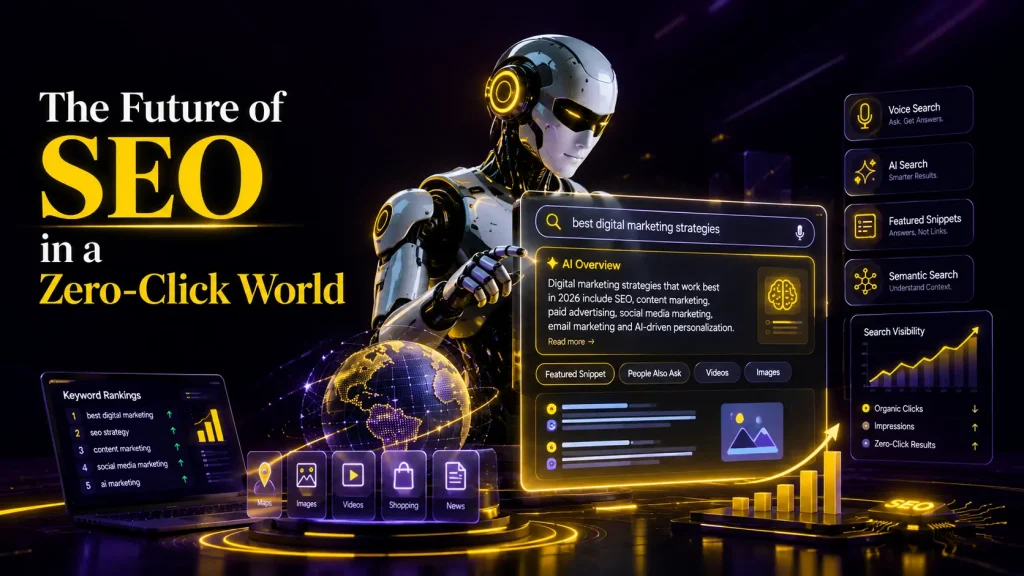
The Future of SEO in a Zero-Click World

Introduction: SEO Is Moving Beyond Website Clicks Search engine optimization is changing. For years the main aim of SEO was clear: come up higher on Google get clicks and send people to your website.. How people search is getting more complicated. Now people can get answers in the search results through AI Overviews, featured snippets, knowledge panels, People Also Ask, local results and other search features. This leads to what marketers call a zero-click search—a search where the user finds the information they want without going to a website. The rise of AI-driven search is making this change more significant. New studies and industry reports show that AI search experiences can lower clicks but make it more important to be seen and mentioned in search results. This does not mean SEO is gone. Instead SEO is growing beyond just bringing traffic to being visible building authority creating brand recognition and having influence. So what will the future of SEO look like? And how can businesses prepare? The Rise of Zero-Click Search Zero-click search happens when people find the answer they need directly on the search results page. They don’t have to click on any website.  For example : if someone asks “What is SEO?” they might see an explanation in a featured snippet or, from an AI answer. Also when people look for businesses, places, meanings, math problems or simple questions the search engine often provides the answer there on the page.  Search features responsible for zero-click experiences include:  AI Overviews  Featured snippets  Knowledge panels  People Also Ask  Local packs  Maps  Product results  Direct answers  The important change is that ranking alone is no longer the SEO goal. A business may rank well. Still receive fewer clicks if the search engine answers the query before the user visits the website. Therefore businesses need to optimize not for rankings but also for visibility, within search features.  Strategy:  Create content that gives answers to clear questions. Use headings that describe the topic, short explanations, bullet points, tables asked questions sections and organized information to help search engines read and understand your content better. AI Overviews Are Changing the Search Experience One of the changes in SEO is how AI is being built directly into search. Now AI‑powered search can pull together information, from websites. AI‑powered search gives users a clear easy‑to‑understand answer in a style. This means people might not have to open pages or compare results themselves anymore. A study published in 2026 showed that when AI gives answers people click less on search results. That’s important for marketers because it means getting rankings, on traditional search isn’t enough anymore.For businesses the real chance is to become a source that AI systems can recognize, trust and even mention. If AI sees your content as reliable it may choose to use it. To do this focus on content that shows: – expertise – Original insights – Clear explanations – Accurate information – Deep coverage of topics – Trusted sources -Managing brand constancyI think it is not enough to write content that only fits keywords. The best content truly answers the questions audience has. Make sure it helps people, not searches. Search Intent and Topical Authority Will Become More Important Traditional SEO used to be about targeting single keywords.. Now it’s more important to understand why people are searching. Search intent is about the goal behind a search query.  For example someone who searches “SEO” might just want to know what it means.. Someone who searches “SEO agency near me” is likely looking to hire a service.  There are four types of search intent: Informational – The user wants to learn or find information. Navigational – The user wants to go to a website or brand. Commercial – The user is comparing products or services before making a decision. Transactional – The user is ready to buy or take action. Of writing random articles around isolated keywords businesses should focus on content that matches each stage of the customer journey. The strategy? Build topic clusters. Start with a topic. Then create content that explores related questions breaks down subtopics includes step-by-step guides compares different options and answers frequently asked questions. Link these pages together using links. This method helps build authority on your site and shows search engines that your website’s a trusted source, in the subject area. From SEO to AI Search Optimization The future of SEO will blend more and more with AI search optimization and Generative Engine Optimization or GEO. This does not mean leaving behind SEO. The real goal is for businesses to mix SEO with new strategies that work well in AI-powered search environments Content should be: Easy to understandFactually accurateWell organizedDirect and usefulSupported by evidence where appropriateWritten around real user questionsRich in unique insights and examples AI systems need information they can understand and use. Clear content structure therefore becomes increasingly important. Strategy: Create direct-answer sections within your content. For example after a heading such, as “What Is Zero-Click SEO?” provide a definition before expanding into deeper details. This structure helps both human readers and search systems quickly understand the point. Brand Authority Will Matter More Than Ever In a world where people don’t click all doing well with SEO is not just about getting someone to come to your website. It is also about making sure your brand is seen and kept in mind. A person might see your brand in an answer created by an AI in a featured snippet in a result on a social media profile or in a search result, without clicking right away. That kind of visibility can still help people remember your brand. This means businesses should build authority across multiple digital channels, including: Website contentSocial mediaBusiness profilesIndustry publicationsReviewsOnline communitiesExpert contributionsDigital PROriginal research Create content that springs from experience and deep knowledge not just copying facts that already exist online. Strategy: I believe that creating content from experience and expertise is better, than rewriting what already exists online. Measuring

Digital Marketing

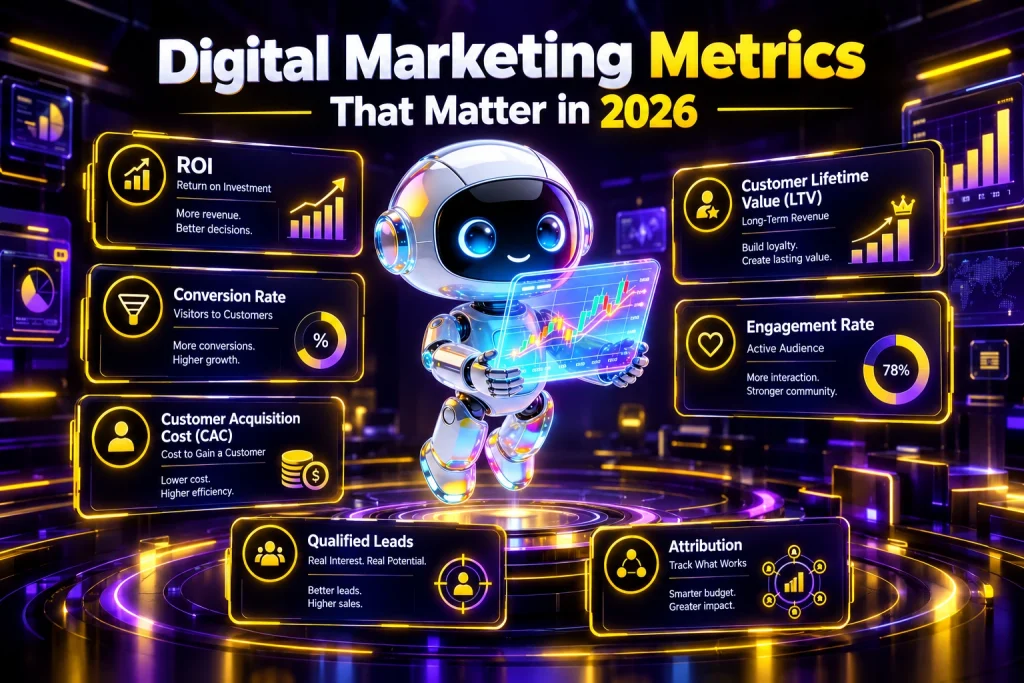
Digital Marketing Metrics That Matter in 2026

Introduction Digital marketing is now a part of growing a business but success is not only, about being seen online. I think knowing the right performance metrics lets a business see what works and where it can get better.In 2026 data-driven marketing will be the way to make choices and get outcomes. Digital marketing will keep growing and performance metrics will guide decisions while data-driven marketing will give results. Return on Investment (ROI) Return on Investment or ROI is a measure that shows how profit a business makes from its marketing efforts. Return on Investment helps companies understand whether their marketing campaigns are financially successful. ROI looks at the money earned compared to the money spent on marketing. When the return is higher than the cost that means the campaign is making money than it costs. This number is very important, for knowing how profitable marketing really is. Formula:ROI = (Marketing Revenue − Marketing Cost) ÷ Marketing Cost × 100 Return on Ad Spend (ROAS) Return on Ad Spend or ROAS is a way to measure the money a business gets back from using paid advertising. This is often used with platforms like Google Ads, Meta Ads and other online advertising tools. ROAS tells how money a company makes for every rupee spent on ads. For instance if a business spends ₹10,000 and gets ₹40,000 in sales the ROAS is 4 to 1. Keeping track of ROAS allows marketers to make choices, about their ads and how they spend their money. Conversion Rate Lorem ipsum dolor sit amet, consectetur adipiscing elit. Ut elit tellus, luctus nec ullamcorper mattis, pulvinar dapibus leo. Cost Per Acquisition (CPA Cost Per Acquisition or CPA is the amount a business spends to get one customer or conversion. It shows how well marketing money is being used. You can use CPA for paid ads lead generation or any other marketing effort. A lower CPA usually means you’re getting customers for money. It’s not the whole story. Marketers should also think about whether the customersre good ones and if they’ll keep coming back and spending more over time. Just because a customer is cheap to get doesn’t mean they’re worth it, in the run. Customer Acquisition Cost (CAC) Customer Acquisition Cost, also known as CAC measures the cost involved in acquiring a new customer. I believe Customer Acquisition Cost is a metric, for any business. Customer Acquisition Cost can include advertising, content marketing, sales expenses, marketing software and other related costs. CAC helps businesses understand how money they spend to get every new customer. When you look at CAC along, with Customer Lifetime Value you can tell if the business is actually making a profit. Reducing the cost to acquire a customer can make marketing efforts work better. This helps the company grow in a way.2 Customer Lifetime Value (CLV) Customer Lifetime Value or CLV tells us how revenue a customer can bring to a business over the whole time they remain with the company. It helps marketers see beyond one sale. A customer who keeps coming brings more value, than someone who buys only once. Companies can increase CLV by providing customer service offering loyalty rewards using ads and running campaigns that keep customers involved. When businesses look at CLV compared to CAC they can decide if spending money to attract customers is worth it, in the long term. Click-Through Rate (CTR) Click Through Rate or CTR is a way to measure how many people click on a link once they have seen it. This is commonly used to see how well advertisements, search results, emails and calls to action are performing. A good CTR usually means that the content or the advertisement is something that people find interesting and relevant. A bad CTR can mean that the headline, the message, the way people are selected or the call, to action needs to be improved. Tracking CTR helps marketers to improve their campaigns and to get more people to interact with their content. Formula:CTR = Clicks ÷ Impressions × 100 Cost Per Click (CPC) Cost Per Click or CPC measures how much money is paid for each click on a paid ad. CPC is a measure for businesses that run search and social media ads. CPC shows marketers how much they spend to bring visitors to their site or landing page. A lower CPC can increase traffic while staying within the budget. Yet CPC must be looked, at together with conversion rate and revenue to see how profitable a campaign really is. However, CPC should be evaluated together with conversion rate and revenue to understand campaign profitability. Formula:CPC = Total Ad Spend ÷ Total Clicks Website Traffic Website traffic is the number of people who come to a website in a time frame. It lets companies see if their marketing efforts are working to bring people.. Just knowing the total number of visitors isn’t enough. It doesn’t tell if those visitors are important or if they will take action. Marketers need to look at where the traffic’s coming from like search engines, ads, social media, email, links, from other sites and direct visits. Knowing the quality of the traffic can help companies focus on the methods that really make a difference. Engagement Rate Engagement rate shows how much people care about your content and how often they act on engagement rate. On Instagram I see that when you post something actions such, as liking, commenting, sharing, saving or clicking are all counted as engagement. The more people do these things the higher your engagement rate goes. This means your content is getting noticed. It helps companies see what types of posts videos or campaigns really connect with their customers. By looking at the engagement rate, over time marketers can make choices. They discover what is effective. Lead Generation Rate Lead generation rate measures how well marketing activities bring in customers. Leads can show up from contact forms, free consultations, newsletter sign‑ups, downloads, product questions or

Scroll to Top