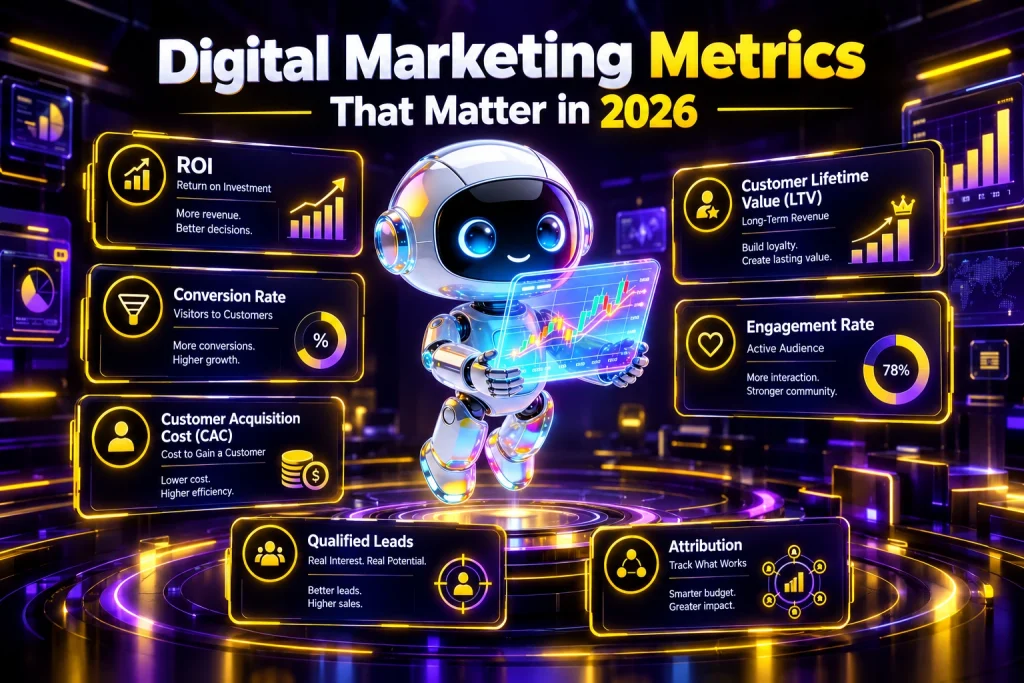
Digital Marketing Metrics That Matter in 2026
Introduction Digital marketing is now a part of growing a business but success is not only, about being seen online. I think knowing the right performance metrics lets a business see what works and where it can get better.In 2026 data-driven marketing will be the way to make choices and get outcomes. Digital marketing will keep growing and performance metrics will guide decisions while data-driven marketing will give results. Return on Investment (ROI) Return on Investment or ROI is a measure that shows how profit a business makes from its marketing efforts. Return on Investment helps companies understand whether their marketing campaigns are financially successful. ROI looks at the money earned compared to the money spent on marketing. When the return is higher than the cost that means the campaign is making money than it costs. This number is very important, for knowing how profitable marketing really is. Formula:ROI = (Marketing Revenue − Marketing Cost) ÷ Marketing Cost × 100 Return on Ad Spend (ROAS) Return on Ad Spend or ROAS is a way to measure the money a business gets back from using paid advertising. This is often used with platforms like Google Ads, Meta Ads and other online advertising tools. ROAS tells how money a company makes for every rupee spent on ads. For instance if a business spends ₹10,000 and gets ₹40,000 in sales the ROAS is 4 to 1. Keeping track of ROAS allows marketers to make choices, about their ads and how they spend their money. Conversion Rate Lorem ipsum dolor sit amet, consectetur adipiscing elit. Ut elit tellus, luctus nec ullamcorper mattis, pulvinar dapibus leo. Cost Per Acquisition (CPA Cost Per Acquisition or CPA is the amount a business spends to get one customer or conversion. It shows how well marketing money is being used. You can use CPA for paid ads lead generation or any other marketing effort. A lower CPA usually means you’re getting customers for money. It’s not the whole story. Marketers should also think about whether the customersre good ones and if they’ll keep coming back and spending more over time. Just because a customer is cheap to get doesn’t mean they’re worth it, in the run. Customer Acquisition Cost (CAC) Customer Acquisition Cost, also known as CAC measures the cost involved in acquiring a new customer. I believe Customer Acquisition Cost is a metric, for any business. Customer Acquisition Cost can include advertising, content marketing, sales expenses, marketing software and other related costs. CAC helps businesses understand how money they spend to get every new customer. When you look at CAC along, with Customer Lifetime Value you can tell if the business is actually making a profit. Reducing the cost to acquire a customer can make marketing efforts work better. This helps the company grow in a way.2 Customer Lifetime Value (CLV) Customer Lifetime Value or CLV tells us how revenue a customer can bring to a business over the whole time they remain with the company. It helps marketers see beyond one sale. A customer who keeps coming brings more value, than someone who buys only once. Companies can increase CLV by providing customer service offering loyalty rewards using ads and running campaigns that keep customers involved. When businesses look at CLV compared to CAC they can decide if spending money to attract customers is worth it, in the long term. Click-Through Rate (CTR) Click Through Rate or CTR is a way to measure how many people click on a link once they have seen it. This is commonly used to see how well advertisements, search results, emails and calls to action are performing. A good CTR usually means that the content or the advertisement is something that people find interesting and relevant. A bad CTR can mean that the headline, the message, the way people are selected or the call, to action needs to be improved. Tracking CTR helps marketers to improve their campaigns and to get more people to interact with their content. Formula:CTR = Clicks ÷ Impressions × 100 Cost Per Click (CPC) Cost Per Click or CPC measures how much money is paid for each click on a paid ad. CPC is a measure for businesses that run search and social media ads. CPC shows marketers how much they spend to bring visitors to their site or landing page. A lower CPC can increase traffic while staying within the budget. Yet CPC must be looked, at together with conversion rate and revenue to see how profitable a campaign really is. However, CPC should be evaluated together with conversion rate and revenue to understand campaign profitability. Formula:CPC = Total Ad Spend ÷ Total Clicks Website Traffic Website traffic is the number of people who come to a website in a time frame. It lets companies see if their marketing efforts are working to bring people.. Just knowing the total number of visitors isn’t enough. It doesn’t tell if those visitors are important or if they will take action. Marketers need to look at where the traffic’s coming from like search engines, ads, social media, email, links, from other sites and direct visits. Knowing the quality of the traffic can help companies focus on the methods that really make a difference. Engagement Rate Engagement rate shows how much people care about your content and how often they act on engagement rate. On Instagram I see that when you post something actions such, as liking, commenting, sharing, saving or clicking are all counted as engagement. The more people do these things the higher your engagement rate goes. This means your content is getting noticed. It helps companies see what types of posts videos or campaigns really connect with their customers. By looking at the engagement rate, over time marketers can make choices. They discover what is effective. Lead Generation Rate Lead generation rate measures how well marketing activities bring in customers. Leads can show up from contact forms, free consultations, newsletter sign‑ups, downloads, product questions or